In fall 2023, my wife and I were exploring new places to move. She was four months pregnant, and we wanted to get closer to my family to start ours. I wasn’t thrilled about returning to Huntsville; we had spent the prior years between major cities on the west coast and east coast. Leaving Los Angeles to move to a small southern town was like leaving dessert for vegetables. But we believed it was the right choice.
One of the first parts of town that we considered was the ‘center’ of the city - downtown Huntsville, because we both like density and walkability. Most of the US, including Huntsville, doesn’t offer much. But we were open to this small square<sup>1</sup>, a big part of our family’s routine.
So when we arrived to town, and got to the area to look at apartments at about midday on a Monday, we were excited about what we were about to see. But downtown, despite its bars, restaurants, and businesses, was completely empty.
The (Abbreviated) History and Purpose of Downtowns
If the genesis of these areas is any reflection, the main purpose of downtown areas is commerce. I think it’s more than that, but I’ll get to that closer to the end.
Downtowns have historically been central business districts (CBDs), and have been used interchangeably with the term. You might personally associate CBDs with the most density, the highest concentration of professionals, or even skyscrapers, but at the core you can typically expect some combination of:
- Professional Service Businesses
- Government offices
- and Businesses that serve 1 and 2 (like restaurants)
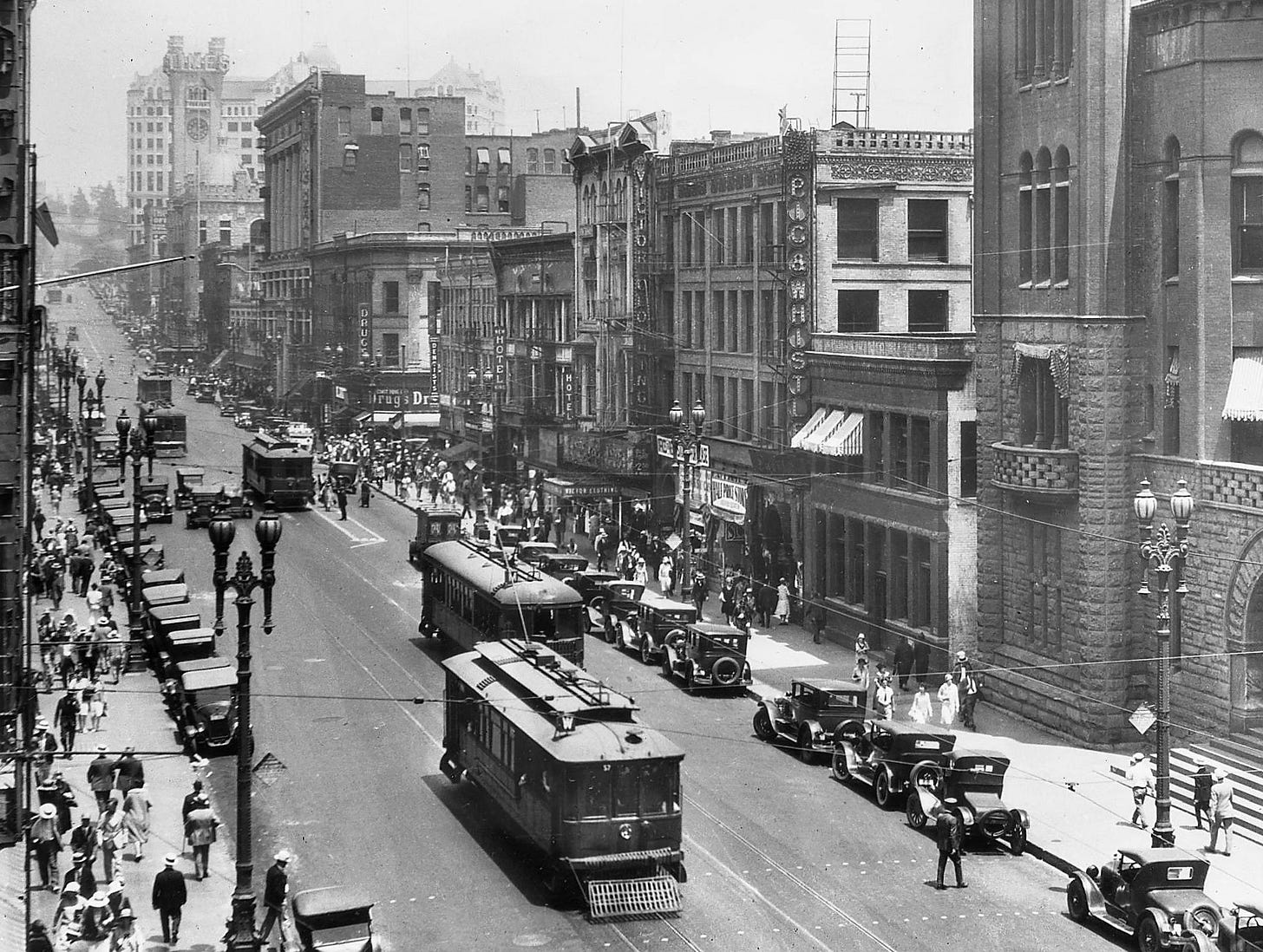
In the late 1800s and early 1900s, downtowns were mostly about commerce. Because of walking as the main mode of transportation, a little bit of commerce goes a long way - you end up with a pretty active area when business is happening there. As manufacturing businesses got bigger in the US during the 1900s, many companies began to move outside of the dense cores, but most of the services businesses and much of the activity still existed in the CBDs.<sup>2</sup>
Over time, as cars and suburban development allowed people to live further away from where they did business, the downtown areas fell into disrepair. Downtowns had to compete with suburbs for business and for residents. Urban crime rates in the mid- to late 1900s spiked, with a lot of (uneven) tension across the biggest cities.<sup>3</sup>
More recently, the pendulum has swung back. Artist colonies and slum houses in downtown areas have given way to new developments, condos, and new amenities. People wanted connection, and the downtown areas provided more of that. Efforts to make city areas safer improved, and a number of professionals and upper middle class people clamored to get back into the cities.
Until COVID-19 hit.
Since 2020, we’ve seen a net migration out of not just downtown areas, but out of cities as a whole in favor of suburbs and exurbs.<sup>4</sup> These are areas where cars are essential, like my hometown of Huntsville, Alabama. In many cases you also need a connecting flight to get back to where you lived before.
As such, many of the downtowns today are also like or becoming like what I saw in Huntsville. There’s no shortage of criticism online for San Francisco’s downtown crisis, Los Angeles has a downtown with an unfavorable reputation, and many of the other downtowns across the country are either struggling with (visible) homelessness, skyrocketing costs, or just general outward migration.
People vote with their feet though right? Why does this matter?
The Urban Doom Loop and The Structural Reasons Why We Need Vibrant Downtowns
For many of my millennial peers, I’ve found that it is easy to be cynical about the remote return-to-work policies. I’ve had a fully remote job for years at different points, so I’ve admittedly assumed dismissible bias with anyone pushing for a return to office. There are, of course, financial incentives at play with corporate real estate and broader media pushes to get people back in person, particularly in downtown areas. The degree varies across the country, but there’s definitely truth to it.
The key thing about cities, however, are that they are interconnected systems. The taxes of one piece of the city depend on the revenue of another. In this case, city governments tax real estate property values based on the value of the real estate. The value of the real estate, of course, is contingent upon how much the real estate cash flows. And if the value of the real estate declines, the tax revenue of the city in turn declines. Real estate finance professionals reading this will know that a struggling commercial building in a city’s downtown area is just as likely to negatively impact local banks and the tax revenue of the city than it is to actively hurt the developer.
This concept of a city spiraling due to its financial situation and departure of residents is called the ‘urban doom loop’, and it’s a threat that a number of cities have been wrestling with since before the pandemic.
In short, cities rely on a number of revenue sources to provide their citizens with the culture, safety, cleanliness, and growth that the city needs to remain attractive. Most people don’t like taxes, and while corporations don’t like taxes either, real estate taxes can provide a valuable source of revenue to a city. The loss of that revenue doesn’t just impact the real estate team.
The Human Reasons Why Downtowns are Struggling
Jane Jacobs talks about the importance of people simply being visible in the streets her classic Death and Life of Great American Cities, and how that fosters safety and vibrancy in itself. It didn’t occur to me until I’d read the book what the actual value of a city, and particularly the downtown area of a city, is.
Downtowns symbolize scaled connection and opportunity within cities.
For people, this means two things - proximity and opportunity must exist together in the downtown areas, and scale to the city at large. My generation, millennials, in particular, see that the intersection of close human connection and opportunities of all kinds in the same physical space multiplies positive outcomes for individuals and groups. While there are certainly many people who find appeal in the suburbs and rural areas, the spirit of suburbia is of a different sort of connection - more insular, narrowly focused, and theoretically more intimate (though practically not the case).
Downtowns represent the physical embodiment of scaled connection and scaled opportunity in cities.
There are a few factors I believe that get in the way of connection and opportunity for individuals and families. On the connection side:
- COVID-era restrictions have people a lot more aware of and sensitive to the risk of close proximity. Strangers could be harboring dangerous illness, and many have become attuned to avoiding that risk for their health and others’.
- Remote work and general social distancing has increased people’s anxiety of being around other people. I have experienced this working remotely - it’s refreshing to come around other people, but unless you’re the purest of extroverts, the shift that social energy requires in a dense downtown core is different from being in front of a screen isolated.
- Increasing distrust with strangers and narratives of violence have reduced the comfort that people have with engaging with people on the streets. This is especially true in cities on the west coast in my experience, but it is relevant across the United States. Visible homelessness, violence, and simple narrative of violence have created a pervasive sense of distrust in areas where trust is most necessary.
In short, the main purpose of downtown areas around fostering connections in a random way while maintaining a tacit level of trust has eroded significantly since 2020. This will take time to rebuild, but it doesn’t help that the perceived opportunity in downtown areas has also decayed:
- Remote work has allowed people to separate their economic opportunity from the physical place that they live. People often feel more connected to their work when they are engaged with the end results, or can see the outcomes. I believe that there are benefits to remote work, but remote work has also separated people a bit more from the “outcomes” of their work - and it has allowed us to see opportunity divorced from location. This can be discomforting, and not even something we realize as children of the digital age.
- The cost of living in downtown areas have increased at a greater rate than other areas further outside of town, so people make the economic tradeoff. This is about safety at the core, and simple rational budgeting, but if downtown starts to feel like more of a cost than a place of opportunity, people will avoid it.
If downtowns do not offer connection, and they do not offer opportunity in the same way as they use to, then there will not be vibrant activity or imagination around the city. This is, in my view, the purpose of downtown - not simply commerce, or places to concentrate business. But rather, these are places to concentrate people for serendipitous connections and opportunity, and where people can realize the value of being in the presence of strangers.
Where do we go from here?
Where I Predict Downtown Will Go in the Next Decade
I believe that 3 factors will impact the growth or further decline of downtown areas in the next decade or so:
- Housing Supply and Prices: I think that housing supply and prices will have an impact on just about everything, but especially the vibrancy of downtown areas and cities as a whole. I hope that we as a country will build more and lower prices so that more people can live in these downtown areas. But I am worried that, especially in the largest cities, the rent (and prices) will still be too high.
- The Impact of Technology on Careers: By day, I work in technology. If the greatest predictions in artificial intelligence prove out, in a decade our relationship with work, careers, and personal finance will be completely different. I think that what’s more likely is that wages will remain suppressed, but this one is very uncertain right now.
- Migration driven by Climate Change: I believe that there will be a lot of climate-driven migration over the next decade. Whether from fires, floods, hurricanes, winter storms, or the government responses to those events, people will move and perhaps move again based on where major weather events happen.
All this is to say, I believe that the most efficient and dynamic places to live, build, and grow will be in and near downtown areas. But we will see how far the pendulum swings back towards the heart of the city.
Footnotes:
1: By a rough look at Google Maps, downtown Huntsville is about 0.09 sq. miles walking.
2: Remus, E. (2018, December 20). The Central Business District in American Cities. Oxford Research Encyclopedia of American History. Retrieved 28 Jan. 2025, from https://oxfordre.com/americanhistory/view/10.1093/acrefore/9780199329175.001.0001/acrefore-9780199329175-e-654.
3: Cullen, Julie Berry, and Steven D. Levitt. "Crime, Urban Flight, and the Consequences for Cities." National Bureau of Economic Research, Working Paper 5737, Sept. 1996, https://www.nber.org/system/files/working_papers/w5737/w5737.pdf.
4: Spell, Lindsay, and Marc Perry. "More People Moved Farther Away From City Centers Since COVID-19." United States Census Bureau, 16 May 2024, https://www.census.gov/library/stories/2024/05/exurbs-city-population.html.